I have long had a complicated relationship with exercise. My core memories of exercise remain the moments when I couldn’t keep up with the people around me. They are centred around what I couldn’t do and how I strayed behind others at a great distance.
For years, I avoided exercise to avoid engaging with those memories, and, God forbid, re-live them. Over the last decade, my relationship with exercise has slowly and gradually changed. Hiking has played a big role in that transformation.
I was launched head first into hiking when I spent a summer completing an internship with an organisation based in the Himalayas. Walking up and down the mountain was the simplest and most cost-effective way to travel between the villages in the community where I was living.
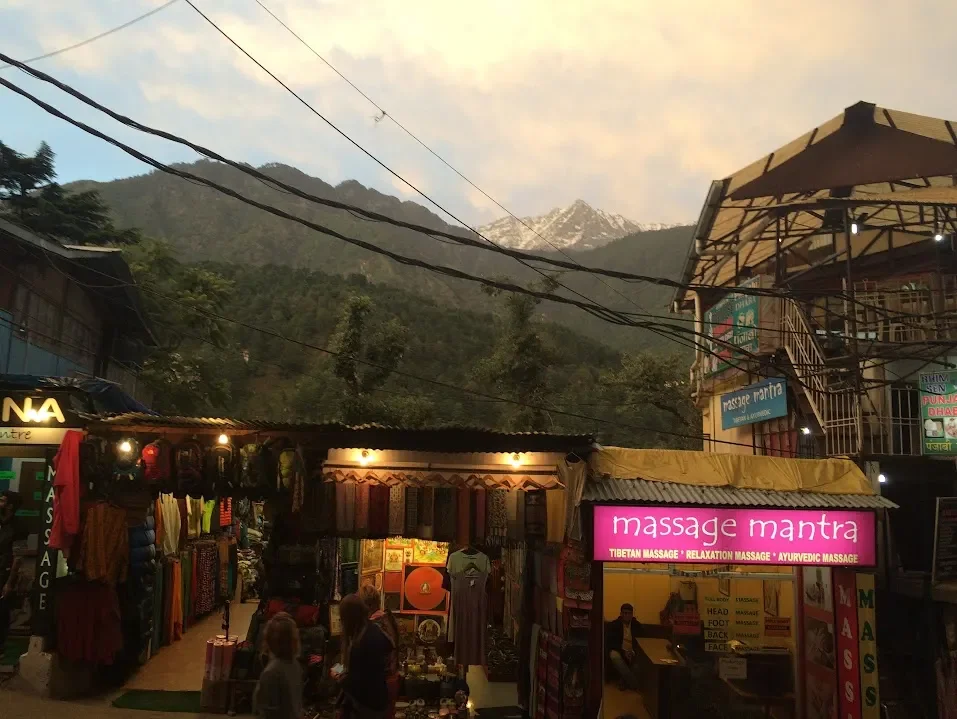
McLoed Ganj, Dharamshala, India 2016
Hiking was baked into everyday life, so I was forced to engage with an activity that was uncomfortable, and, by extension, with the fears and insecurities that I had pushed away by avoiding exercise altogether. In that other-worldly experience, where we did everything in community, I had to learn to communicate about my limitations and ask for others to accommodate them. I did this with great discomfort, less grace than I would have liked, and often only once I had already pushed myself beyond my limits. But it was progress. My first of many baby steps towards accepting my body as it is and trusting that others care enough about me to honour my needs.
During COVID, my husband and I were living back in our home province. We had greater access to nature and availed of it by hiking more regularly. My husband’s best friend is an avid hiker. He had completed the Appalachian Trail a couple of years earlier, and we often hit the trails all together.
When we first started hiking together, I found myself pushing my limits, trying to perform at the standard that I thought was necessary to “keep up” with someone of his calibre. Eventually, I found myself desperately asking for a break between gasps for air. I had put off the request because I was expecting that our friend would be frustrated by the short distance we’d travelled before needing to stop. He just responded “okay, cool” and then inspected the tree nearest us and talked about its features. Rather than an inconvenience, he seemed to treat it as an opportunity to admire the beauty around him more closely.
As our group set out on more adventures and we became more familiar, I became more comfortable asking for breaks. I learned to ask when the need first arose, rather than waiting until I was on the brink of collapse. Over time, I allowed myself to increase the length of breaks. I learned to base their length on how long my body needed to recover, rather than on when I feared the group’s patience might expire.
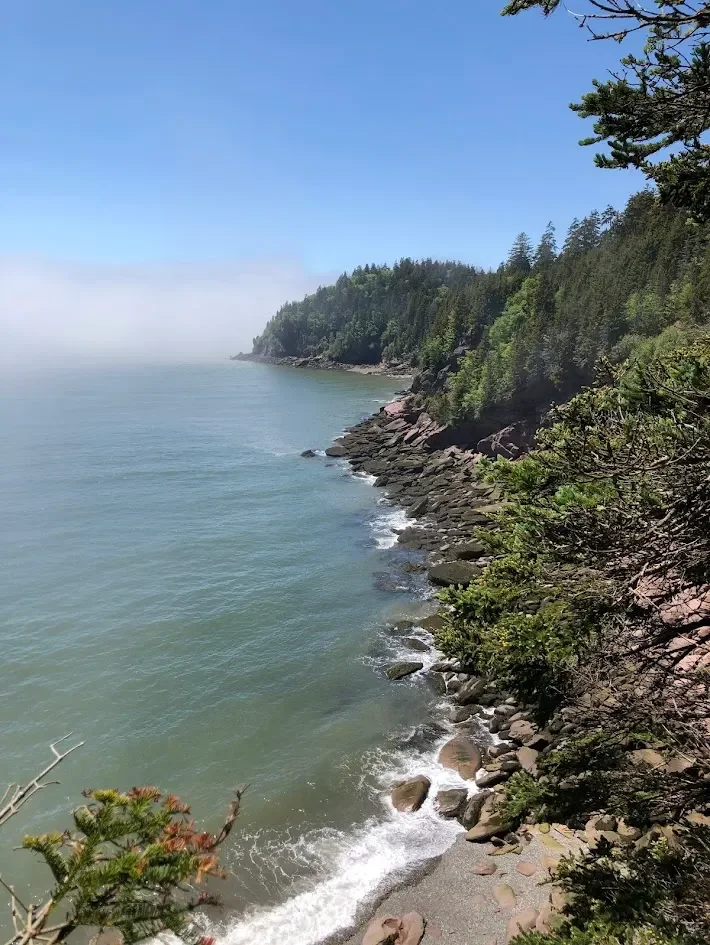
Fundy National Park, Alma, New Brunswick, Canada 2021
One day, when I asked again for a break, our friend proposed: “What if, from now on, you hike in front. That way, you can set the pace.” “Wouldn’t that be annoying for you” I replied. “I’m outside, I’m hiking, I’m with my friends; I’m happy. I don’t care how fast we go. I just love being in nature”. And this honestly changed everything.
At first, I was apprehensive, and still found myself pushing my limits out of fear that I would ruin the experience by moving too slowly or stopping too frequently. I had to learn to actively trust what he was telling me over the voices in my head that propelled me to push harder and move faster.
During our hikes, when I was worried about taking a break, I would remind myself that it makes sense that I am afraid of reliving the experiences that I’d had as a child and feeling judged for my physical abilities. Sometimes, when my husband could tell that I was pushing myself he would gently say “We can take as much time and as many breaks as we need”, and our friend would chime in with an enthusiastic “Absolutely!”
My husband and I spent last Easter with family in the Lake District. This part of Northern England boasts incredible hikes; heights from which the shimmering lakes for which the region is known become even more breathtaking. So, we ventured off, just the two of us to try to capture some of the District’s beauty.
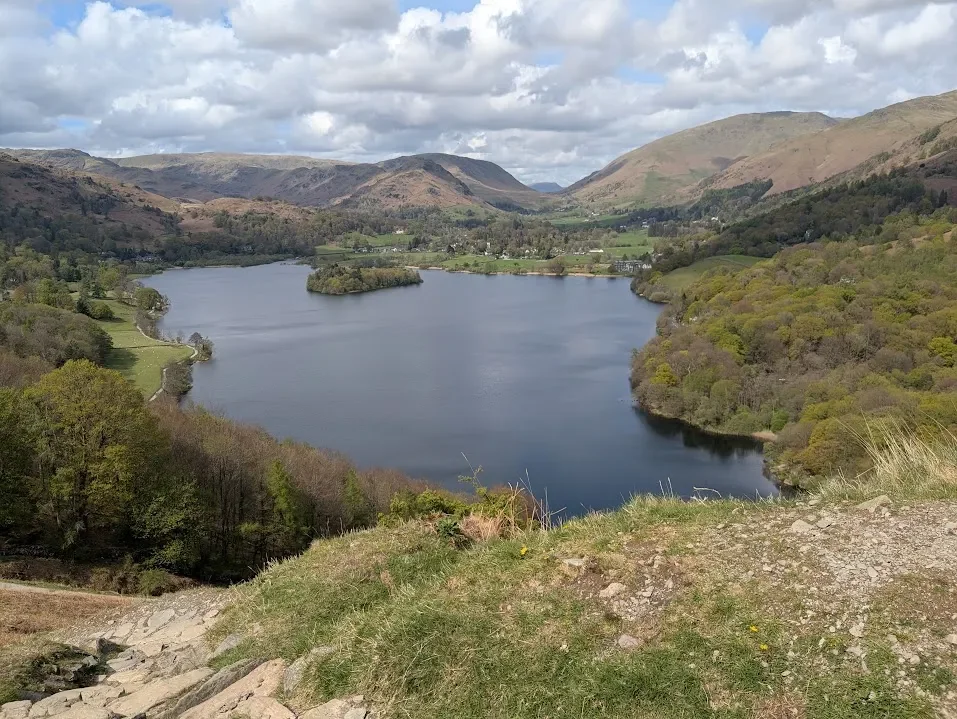
Loughrigg Fell, Cumbria, England 2025
The hike that we selected ended up being more challenging than we were expecting. Initially, the trail led us through gradual inclines with regular plateaus, and I comfortably took breaks as needed. The hike changed significantly when, about 45 minutes in, we approached what appeared to be an endless set of stone stairs leading to the peak. Stairs are really my enemy number one, in the sense that consistent incline puts a lot of stress on my system, so I looked at them with fear and a sense of defeat.
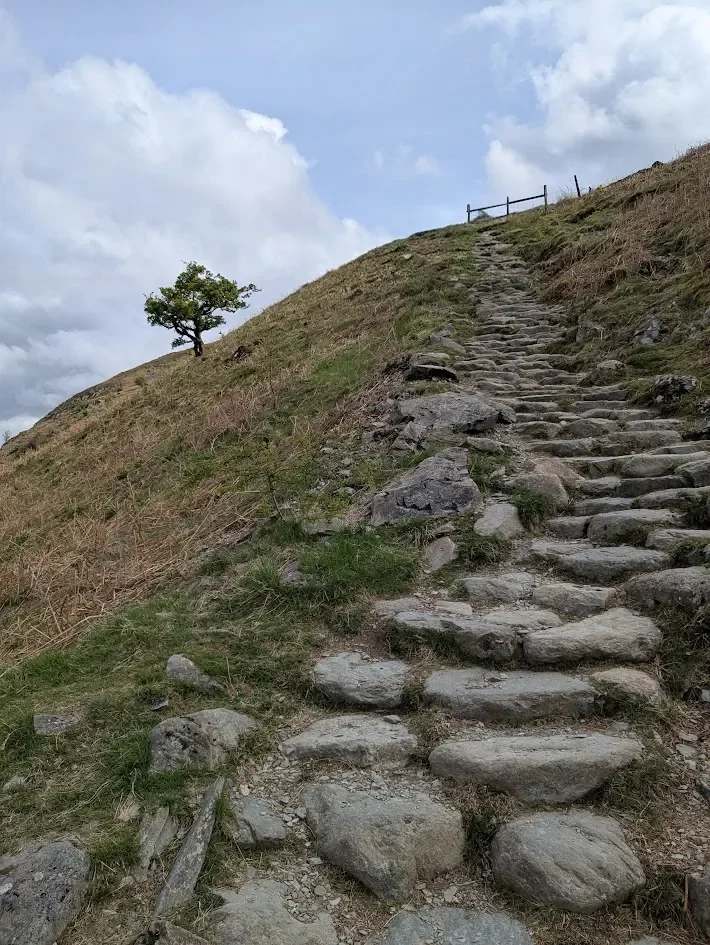
Loughrigg Fell, Cumbria, England 2025
My husband could sense my hesitancy and kindly reminded me “we can take as much time and as many breaks as we need”. With that encouragement, we started to ascend. At times, I noticed myself clinging on to old patterns. When I could see that we were only so many steps away from a particular landmark, my instinct was to speed up to reach it, in spite of my already heavy breathing. I had to actively remind myself that I am entitled to a break wherever and whenever I need.
The more I talked to myself and communicated with Alex, the more comfortable I became taking the time and space that I needed. I stopped judging myself. And with that release came a sense of freedom from other people’s judgments about my physical abilities. If I had no reason to judge myself, then other’s judgements, whether real or perceived, had no sting.
Throughout this ascent, I reflected on a text interaction that I’d had with a close friend the day before. While in the Lake District, we went to a print shop where they sold goods with hiking-related expressions and Northern Slang printed on them. I naturally sent a good number of photos of various prints and badges to my friend from Yorkshire. I sent her photos of expressions I’ve heard her say or cute animals that I knew she would like. And then I sent her the photo of a badge that says “Reluctant Hikers Club” with the tagline: “I hiked, I cried…but I made it in the end”. I included a caption “it me.” And her response was “Awww. You’re not reluctant. Your body just needs more time!”
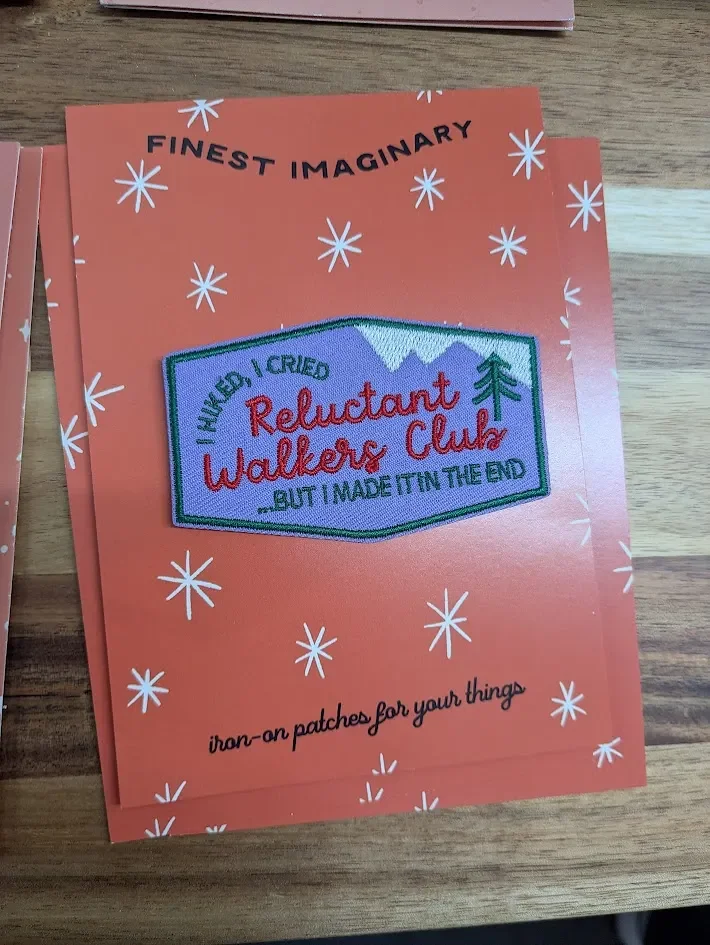
National Park Print Shop, Ambleside, Cumbria, England
For so much of my life, I learned to mask my limitations with disenjoyment. It was easier to pretend that I didn’t enjoy exercise than it was to accept my limitations and ask others to honour them. As I have been honest with people and invited them into the complicated relationship with exercise and allowed them to see my body’s limitations, the more encouragement I have received to show up, listen to my body, and go at my own pace. I thought that people would only see me as holding them back. I didn’t even fathom the possibility that they might be happy to go at my pace just so that I could be there.
So, up I continued to climb, with renewed pride and comfort that I could take my time. With each step I felt more grateful for what my body could do, and for how I have learned to work with my body. And then, we reached what, from the bottom of the stairs, had looked like the peak. I was immediately deflated when I saw the more than 100 metres that still separated us from the true peak of Loughrigg Fell. I hadn’t yet “made it”. And all of the pride that I felt just moments before vanished with the realisation that I still had so far to go.
I instinctively pressed forward. I dropped my head and started climbing at a much faster pace than we had been going up until that point. Then Alex reminded me of our mantra: “we can take as much time and as many breaks as we need”. But this time, he added “just because there is farther to go doesn’t mean that we have to keep climbing”.
Without thinking I sharply replied “Yes we do. We’re here to do the hike.” “No, we’re here to hike. And we’ve been hiking”, Alex said in reply. “I’m happy to keep going, but let’s actively decide if that’s what we want. We don’t have to keep climbing just because there is more mountain”. In complete honesty, this option had never occurred to me, so we took some time to consider how we wanted to move forward. We drank water, took some pictures, and then decided to keep climbing.
We reached two more false peaks and there was still much farther to go if we were to reach the ultimate peak of Loughrigg Fell. I vividly remember fighting the shake in my legs while walking the first 10 steps forward. I knew my body was tired, but I still felt propelled forward by this arbitrary goal of reaching the very top. After ascending maybe 20m from the plateau where we last rested, I asked if we could stop again for a snack.
During that break I wrestled with the incongruence between what my body and mind were each telling me. My body knew that I had little left to give. My mind wanted to push forward, to reach the highest of heights. In the end, we decided that the rock on which we sat for a snack was our peak, and started our steep descent.
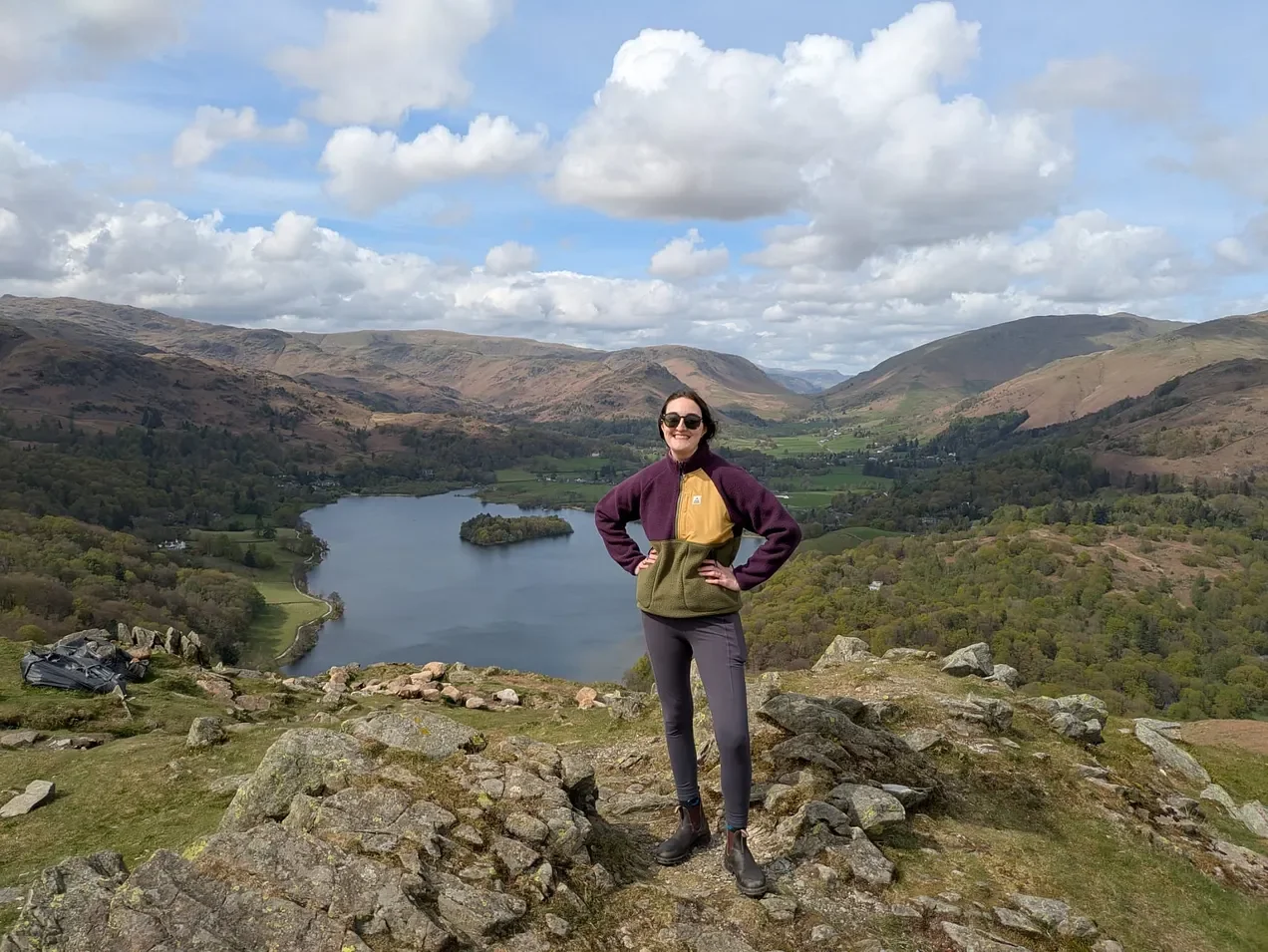
Loughrigg Fell, Cumbria, England
My experience hiking in the Lake District made me aware of my tendency to discredit my accomplishments once I see that there are greater heights to reach. I was so proud that I climbed those stone stairs and that I did it at a pace that allowed me to honour my body. But that pride vanished the moment that I saw a higher peak on the horizon. As soon as I had finally found joy in accepting my limits, a whole new issue cropped up: my brain telling me that going at my pace would never be enough if I wanted to reach the peak. I had to choose between honouring my body and reaching the peak.
While sitting on a high rock, eating an apple to try to make my legs stop shaking, I sat with this revelation as I watched others on the trail frolic on the peaks above me. I realised that, in my moment of defeat, I was repeating a pattern that has cropped up time and time again in my life. As soon as I accomplished a goal, I moved the benchmark.
As we climbed down the side of the Fell, I reflected on my tendency to discredit my accomplishments and lose my sense of pride in myself once I saw someone else rise higher. I thought immediately of my first job. I landed my dream job after graduating from law school. I had set my sights on it and worked hard to get there. I couldn’t believe my fortune. Until I started to talk to other people. A handful of the young professionals in my cohort were clerking at higher, more prestigious courts the following year. When I learned of their success, I became disappointed with my accomplishment. I moved the benchmark once I attained what I was aiming for because I saw people on a higher summit. What was behind me suddenly didn’t matter because I could see that there was more ahead. I hadn’t done enough.
“What was behind me suddenly didn’t matter because I could see that there was more ahead.”
I repeat this pattern in nearly all areas of my life: previous weight loss, baking challenges, singing, public speaking. Once I successfully accomplished what I had set out to do, I was suddenly comparing myself to someone further along. And once I saw it, I couldn’t unsee it.
So in the year since I had this awakening halfway up a mountain, I’ve tried to observe this pattern in myself and find opportunities to practice resisting it. And in all of that practice, none of my experiences of resistance are more vivid than the ones that took me back to the mountains and the visuals that have inspired this journey of awareness and resistance.
My parents came to visit in October. My parents recently visited. It was an amazing opportunity to have quality time and to dedicate time to seeing parts of this Island that I had yet to explore. One of those destinations was Sliabh Liag, which hosts the highest accessible sea cliffs in Europe. We took a bus to the viewing platform, from which we had a beautiful view of the cliffs. There was a trail from the viewing platform which led to the top of the mountain. My Mom and I decided to follow it up, hoping that an even more breathtaking view might await us, despite the fog that surrounded us.
As we climbed, Mom and I had identified a destination up the mountain that we decided looked like a good stopping point. Once we reached it, Mom was interested in going further. So we did. This happened a few times, and fellow climbers who we met on their way down spurred us along, encouraging us that we weren’t far from the summit. I started to feel unsteady on my feet; shaking in my legs, burning in my chest. Initially, I said that I needed a break, but after a few minutes told my Mom that this was my peak for the day. She wanted to keep climbing, so I encouraged her to keep climbing to her peak.
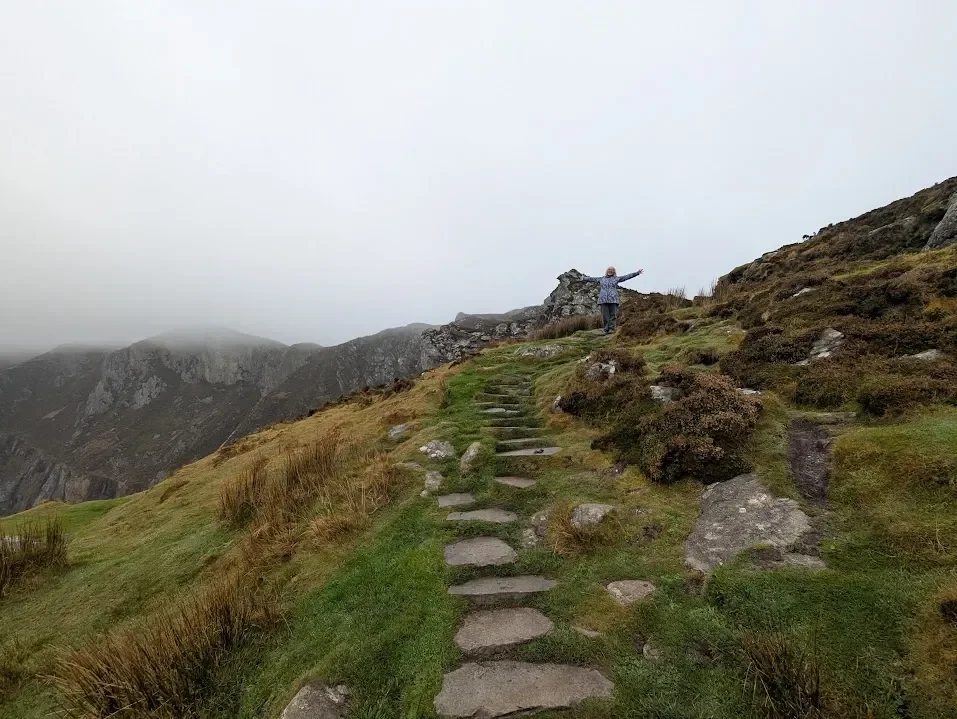
Sliabh Liag, Donegal, Republic of Ireland
When I took this photo of my Mom, I felt a tinge of regret; thinking to myself how nice it would have been to be up there together. And in that thought, I heard a new version of the same message that has been propelling me forward for years: you’re not doing enough. You’ve only reached a false peak.
On this day, I didn’t let that thought propel me forward. I remained at my peak. And I was so proud of myself. My legs were even more unsteady on the way down, and I continuously thanked myself for not pushing to reach further. I could celebrate my Mom’s peak without chastising myself for not striving to reach it.
My sense of pride after that hike didn’t come from reaching the highest peak, but from accepting the heights that I could reach that day as high enough for me. For honouring my body and choosing my destination based on what I wanted, needed, and felt like I could handle. I decided to celebrate what I’d achieved and not treat it as just another false peak.